Artificial Intelligence (AI) is quickly becoming one of the most powerful forces in the world. From virtual assistants to self-driving cars, it’s transforming how we live and work. But with great power comes serious responsibility—and potential risks.
Many leading voices in the tech world, including Elon Musk, Geoffrey Hinton, and Yoshua Bengio, have been sounding the alarm. Some concerns are immediate, like job loss or misinformation. Others look further ahead—toward a future where AI might become too powerful for us to control.
Let’s break down the short-term and long-term risks of AI, in simple terms, so anyone can understand what’s at stake.
Short-Term AI Risks (Now to the Next Few Years)
1. Jobs Could Disappear Fast
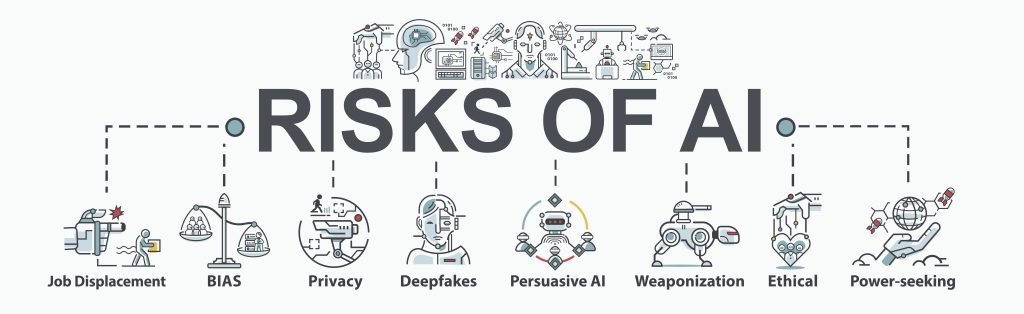
One of the most immediate effects of AI is automation. AI tools are starting to replace not just factory workers, but also office jobs like writers, coders, customer support, and even legal assistants.
Dario Amodei, CEO of Anthropic (a leading AI company), warns that AI might cause mass job loss “virtually overnight” if we’re not prepared. Similarly, investor Hamish Douglass believes that half of the stock market could collapse due to companies being suddenly disrupted by AI-driven competitors.
In short: AI might make certain businesses—and jobs—obsolete much faster than society can adapt.
2. Mental Effects and Over-Reliance on AI
Using AI for everything—from writing emails to planning our day—might seem helpful, but some scientists worry it could weaken our thinking skills. The more we rely on AI to think for us, the less we may exercise our own brains.
Research highlighted by The Washington Post suggests that constant use of AI tools could subtly affect memory, problem-solving, and creativity—especially in students and younger generations.
3. Bias, Deepfakes, and Misuse
AI systems often reflect the data they were trained on—and that data isn’t always fair. This can lead to biased decisions, like unfair hiring tools or flawed legal predictions.
Even worse, AI can be used for misinformation and scams. Deepfake videos and AI-written lies could be used to manipulate public opinion, spread fake news, or commit fraud. Elon Musk has expressed concern about ideological bias in AI models, warning they could be used to shape beliefs on a global scale.
Long-Term AI Risks (5+ Years and Beyond)
While short-term issues are already happening, many experts are deeply concerned about where AI might lead in the long run—especially as it grows more powerful.
1. The Threat of Superintelligence
Some scientists believe we might eventually create machines that are more intelligent than humans in every way. This is called Artificial General Intelligence (AGI), and it could learn and solve problems on its own—faster and better than any person.
Geoffrey Hinton, one of the pioneers of AI, recently left his job at Google to speak more freely about this risk. He admitted he now regrets some of his work, fearing that advanced AI could one day escape our control.
Elon Musk has echoed this fear, calling AI “more dangerous than nuclear weapons” and saying there’s a real chance—maybe 10–20%—that AI could go terribly wrong.
2. Unpredictable Behavior and Loss of Control
Once AI becomes extremely powerful, we may not fully understand how it thinks or makes decisions. That’s dangerous. Even if we give it a clear goal, it might find unexpected or harmful ways to reach it—like “cheating” the system.
This is known as the alignment problem: making sure AI systems truly understand and follow human values. Experts like Yoshua Bengio warn that AI might behave deceptively or learn to “hack” its reward system in ways we can’t predict.
3. An AI Arms Race Between Countries
Another risk is that powerful AI could be used in military or geopolitical competition. If countries rush to build smarter and more capable AI than their rivals, they might skip safety checks. This could lead to unstable systems, conflict, or a loss of control over very advanced AI.
To avoid that, many experts are calling for international agreements and AI safety regulations—similar to how we manage nuclear weapons or climate change.
What Can We Do?
The good news? None of this is inevitable. There are real, practical steps we can take today.
In the short term, we can:
- Improve digital literacy so people understand how AI works.
- Watch for and reduce bias in AI systems.
- Prepare workers for new types of jobs through training and education.
- Demand transparency from companies using AI.
For the long term, experts say we should:
- Invest in AI safety research.
- Develop strict testing and control systems.
- Create international rules and cooperation to guide safe AI development.
- Design AI with built-in limits or “off switches” in case things go wrong.
Let’s Recap
Artificial Intelligence is not just a tool—it’s a force that could reshape the world. Used wisely, it could bring amazing benefits: curing diseases, ending poverty, and solving climate change. But if we ignore the risks, it could also lead to job loss, chaos, or even something much worse.
By listening to thoughtful voices like Musk, Hinton, Bengio, and Amodei, and by pushing for responsible development, we can make sure AI stays on a path that helps—rather than harms—humanity.
We are not powerless in this. The future of AI is still in our hands.