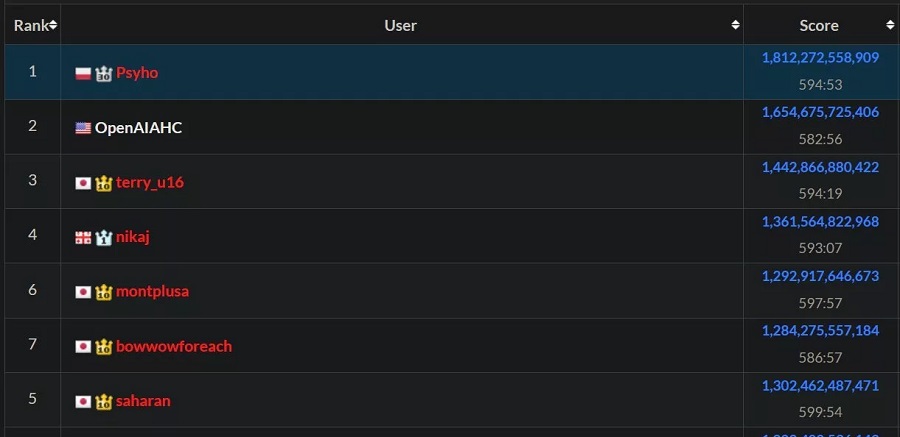
A 42-year-old Polish programmer has successfully defeated OpenAI’s advanced custom AI model in a grueling 10-hour coding marathon. This victory, achieved in one of the world’s most prestigious programming competitions, once again highlighted the superiority of human creativity and intuition over raw machine computational power.
The 2025 AtCoder Global Contest hosted an unprecedented showdown this year: “Human vs. Artificial Intelligence.” In this event, 12 of the world’s top programmers faced off against a formidable new challenger—an AI model named OpenAIAHC, specially developed by OpenAI to tackle complex problem-solving tasks.
The challenge was a highly difficult optimization problem: finding the shortest possible path for a robot within a 30×30 grid. These types of problems, which lack definitive and complete solutions, rely heavily on creativity, intuition, and the ability to devise unique strategies.
After ten intense and exhausting hours of competition, Przemysław Dębiak, a seasoned programmer from Poland, emerged victorious by a margin of 9.5%, defeating the AI and claiming the 500,000 yen prize.
The Duel: Polish Programmer vs. OpenAI AI
Przemysław Dębiak is a well-known figure in the world of algorithmic programming. A member of the high-IQ society Mensa and a four-time champion of the TopCoder Open Marathon, Dębiak has previously worked as an engineer at OpenAI itself, contributing to the AI project for the Dota 2 game (known as OpenAI Five).
Following his victory, Dębiak—who reportedly slept only 10 hours over the course of three days—posted on social media platform X: “Humanity (for now) has won!” The win even drew praise from Sam Altman, CEO of OpenAI, who responded briefly: “Nice work, psycho.” “Psycho” is Dębiak’s well-known programming alias.
The Japanese director of the competition attributed Dębiak’s win to his unique approach. While the AI excelled in “raw optimization” and rapid computation, it ultimately fell short in the face of human creativity. Instead of relying solely on computational brute force, Dębiak used clever shortcuts and informed guesses to reach an optimal solution—a skill that machines have not yet fully mastered.
This victory comes at a time when AI is advancing at a staggering pace in the field of coding. According to the Stanford AI Index, AI coding benchmark success rates skyrocketed from 4.4% in 2023 to 71.7% in 2024, and tools like GitHub Copilot are now used by over 90% of developers.