Artificial Intelligence (AI) is all around us—helping your phone recognize your voice, recommending shows on Netflix, and even powering chatbots like me. But how does AI actually learn? Is it like teaching a child or more like programming a computer?
In this beginner-friendly guide, we’ll walk you through the basic idea of how AI “learns” in simple, everyday language. No math, no jargon—just clear explanations.
What Does “Learning” Mean for AI?
When humans learn, we gain knowledge from experience. For example, after falling off a bicycle a few times, we figure out how to balance. AI doesn’t learn quite the same way, but the goal is similar: it improves at a task over time by using data.
In short: AI learns by finding patterns in data.
Think of AI Like a Student
Imagine you’re teaching a student how to tell cats and dogs apart. You show them 1,000 pictures—some of cats and some of dogs. Over time, the student notices that cats often have pointy ears and smaller noses, while dogs have broader faces or longer tongues.
AI does the same thing—but instead of “seeing” like we do, it uses numbers and math to spot patterns.
This learning process is called training.
How Training Works (in Simple Steps)
Here’s how AI learns step by step:
1. Collect Data
AI needs examples—just like students need study material. For example, if we want AI to recognize fruit, we give it thousands of labeled pictures of apples, bananas, and oranges.
2. Give It a Goal
We tell the AI what the task is. For example, “Look at a picture and say which fruit it is.” This task is called a model—a kind of smart system built to solve one specific problem.
3. Practice (Training Time!)
The AI looks at each example, tries to guess the answer, and checks if it’s right. When it’s wrong, it adjusts itself slightly to do better next time. It repeats this thousands (or millions) of times.
It’s like trial and error on fast-forward.
4. Test It
After training, we test the AI with new data it hasn’t seen before. If it performs well, we know it has truly learned—not just memorized the training examples.
What Type of AI Are We Talking About?
There are different kinds of AI, but the one doing most of the amazing things today is called Machine Learning. Within this field, there’s a powerful method called Deep Learning, which is used in voice assistants, self-driving cars, and image recognition.
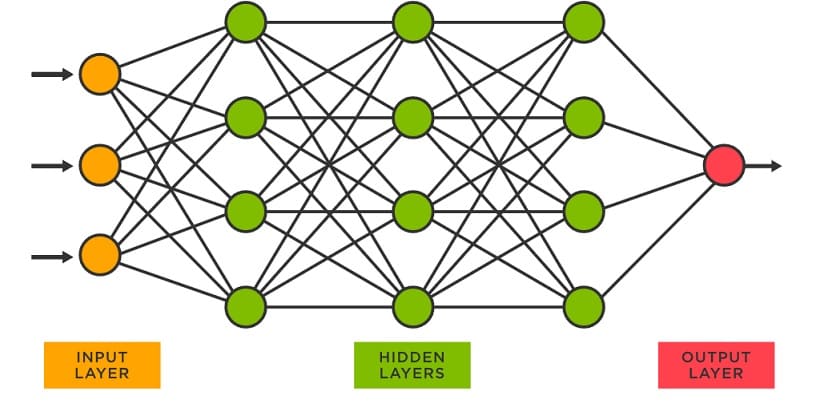
If Machine Learning is like teaching a student, then Deep Learning is like teaching a super-student who can handle much more complex problems by using something similar to a brain—called a neural network.
Common Misunderstanding: Is AI Just a Big Database?
No, AI is not just a giant search engine or a dictionary. It doesn’t store all answers in a list. Instead, it learns general rules from examples. For instance, it doesn’t memorize every dog it has seen; it learns the features that make something “dog-like.”
Why Does AI Need So Much Data?
The more examples AI sees, the better it learns. It’s like studying for a test—reading more examples gives you a better chance of recognizing questions. With too little data, AI might make silly mistakes.
Can AI Learn on Its Own?
Yes and no.
Some AIs can improve themselves over time by learning from new data (this is called “online learning”), but they still need humans to:
- Decide what the goal is
- Collect or label data
- Monitor their progress
So AI is smart, but not fully independent.
Let’s Recap: AI Learns Like a Super Fast Student
To sum it up, AI learns by:
- Looking at lots of data
- Trying to find patterns
- Practicing over and over
- Getting better each time
It’s not magic—it’s smart math powered by huge computers and data.
Next time you hear about AI doing amazing things, remember: behind the scenes, it’s just a very fast learner, trained by humans to spot patterns and make decisions.