


ChatGPT: One of the World’s Most Widely Used AI Tools – What Are the Hottest Topics?
ChatGPT is one of the most widely used artificial intelligence tools in the world. But what topics are trending on this chatbot?
As public adoption grows, the usage patterns of ChatGPT are evolving. Although questions related to software development have significantly declined compared to 2024, they still hold the largest share—indicating that developers remain one of the primary user groups, relying on ChatGPT for coding and related applications.
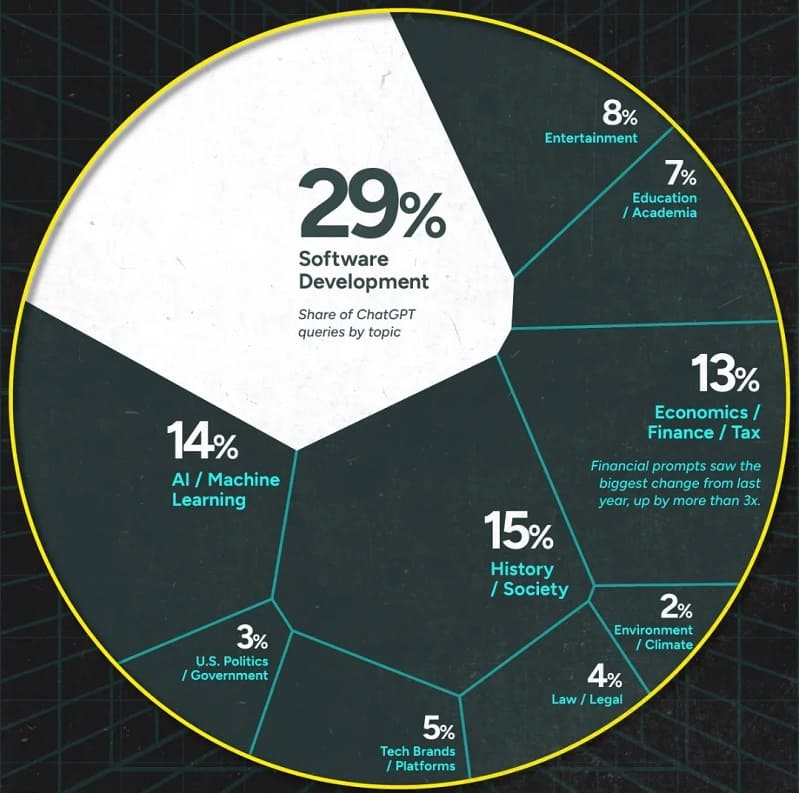
According to new data from Sensor Tower, the most popular topics currently on ChatGPT include:
- Software Development (29%)
- History and Society (15%)
- Artificial Intelligence and Machine Learning (14%)
- Economics, Finance, and Taxation (13%)
- Entertainment (8%)
- Education (7%)
- Tech Brands and Platforms (5%)
- Law and Regulations (4%)
- U.S. Politics and Government (3%)
- Climate and Environment (2%)
Software development accounts for 29% of all user requests on ChatGPT. Users not only utilize the tool to simplify coding in various languages but also view it as a solution for debugging and automating tasks.
Findings from a separate study show that beginner programmers (with less than one year of experience) are the most optimistic about the future of artificial intelligence.
Following software development, the next most common category is history and society, making up 15% of all queries. Topics related to AI and machine learning are not far behind.
The “Economics and Taxation” category saw a significant increase, with its share more than tripling compared to last year. In this area, users are seeking analyses of financial markets, macroeconomic trends, and stocks.
Recent data shows that ChatGPT is gradually transforming from a specialized tool for developers into an everyday assistant for a wide range of users.
The diversity of user requests reflects both the broad capabilities of ChatGPT and the shifting behaviors of users as they engage with artificial intelligence.


